
BlueRoots and Color for Carbon are among the nine projects selected by the PETRONAS initiative focused on developing Nature-Based Solutions in Brazil
CCARBON/USP has reached a new milestone in its research and innovation activities with the selection of two projects in the PETRONAS Brazil Innovation Challenge: BlueRoots and Color for Carbon (C4C). The selected projects were announced during ROG.e 2026, held from September 21 to 24 in Rio de Janeiro.
Launched by PETRONAS in November 2025, the Brazil Innovation Challenge was created to foster the development of Nature-Based Solutions (NbS) capable of contributing to the reduction and removal of greenhouse gases while linking ecosystem conservation and restoration to environmental and social benefits. The initiative, enabled through Research, Development and Innovation investments regulated by Brazil’s National Agency of Petroleum, Natural Gas and Biofuels (ANP), received more than 100 proposals from universities, companies, and other Brazilian institutions.
At the end of the process, nine projects were selected, distributed across three major themes: terrestrial forest restoration and carbon sequestration; blue carbon ecosystems, with a focus on mangroves; and agroforestry and regenerative agriculture. The two projects linked to CCARBON/USP represent two of these strategic areas.
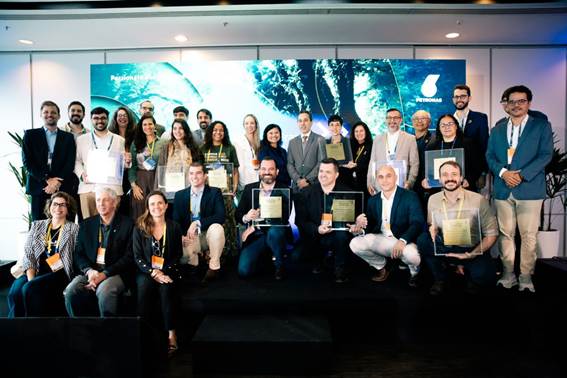
Representatives of the nine projects selected in the PETRONAS Brazil Innovation Challenge, alongside the PETRONAS Brazil team and partners, during the award ceremony held at ROG.e 2026 in Rio de Janeiro.
BlueRoots: new strategies for mangrove restoration
Led by Prof. Tiago Osório Ferreira, Dissemination Director at CCARBON/USP and Associate Professor in the Department of Soil Science at ESALQ/USP, BlueRoots – Innovative mangrove restoration strategies to maximize carbon credits and community impacts is part of the Challenge’s Blue Carbon track.
Planned to run for 36 months, the project aims to develop and test strategies capable of increasing the efficiency of mangrove restoration and enhancing the carbon gains associated with the recovery of these ecosystems, while also maintaining a strong focus on benefits for local communities.
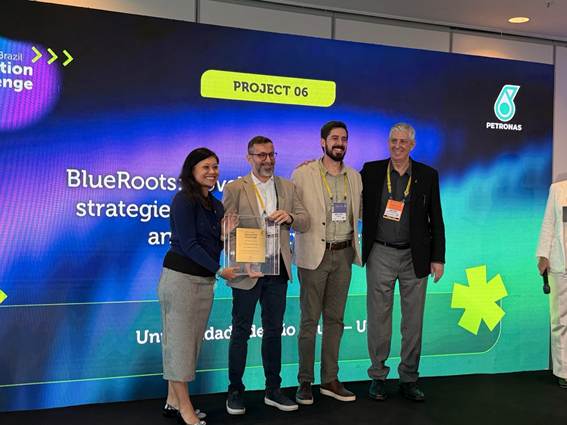
From left to right: Suhana Sidik, Country Chair of PETRONAS in Brazil; Prof. Tiago Osório Ferreira, BlueRoots Coordinator and Dissemination Director at CCARBON/USP; Rodolfo Fagundes Costa, Dissemination Manager at CCARBON/USP and Project Manager; and Jonas Castro, Head of R&D at PETRONAS Brazil, during the ceremony recognizing the projects selected in the PETRONAS Brazil Innovation Challenge, held at ROG.e 2026.
BlueRoots will also include the participation of Prof. Dr. Gabriel N. Nóbrega, from the Department of Soil Science at the Federal University of Ceará (UFC), and Prof. Dr. Angelo Fraga Bernardino, from the Department of Oceanography at the Federal University of Espírito Santo (UFES). Both are associate researchers at CCARBON/USP and will contribute complementary expertise in soil science, biogeochemistry, ecology, and coastal and estuarine processes. This collaboration reinforces the interdisciplinary and interinstitutional nature of BlueRoots, supporting the assessment of mangrove restoration strategies, their effects on ecosystem functioning, and their potential to increase and stabilize carbon stocks.
The research is based on the understanding that restoring vegetation cover is only one stage in the recovery of a mangrove ecosystem. For restoration projects to contribute more effectively to climate change mitigation, it is necessary to understand how different practices influence plant establishment, root development, carbon accumulation and stabilization in soils, and the ecosystem’s recovery trajectory.
BlueRoots will integrate experiments under controlled conditions with field validation, including strategies for seedling production and establishment, management during restoration, and assessment of the mechanisms responsible for carbon accumulation and stabilization.
In addition to its scientific and technological dimensions, the project incorporates knowledge transfer and community participation, seeking to transform research results into tools that can support restoration initiatives across different mangrove regions.
The proposal selected by PETRONAS highlights precisely this combination of restoration, carbon, and community impact.
Color for Carbon: when landscape regeneration also creates color
The Color for Carbon (C4C) – Regenerative Tinctorial Agroforestry as a Nature-Based Solution project is led by Prof. Pedro Brancalion, Innovation Director at CCARBON/USP and Associate Professor in the Department of Forest Sciences at ESALQ/USP, with Thaís Silvestre Sanches Antichera, an associate researcher at CCARBON/USP, serving as Project Manager. The initiative brings together expertise in ecological restoration, agroforestry systems, carbon, biodiversity, and the development of sustainable value chains, and also includes collaboration with the Institute for Technological Research of the State of São Paulo (IPT).
C4C proposes to develop and evaluate an innovative model of regenerative tinctorial agroforestry, combining forest and food species with plants capable of providing natural pigments in a productive system designed to simultaneously restore degraded areas, increase carbon stocks, enhance biodiversity, and create new income-generation opportunities.
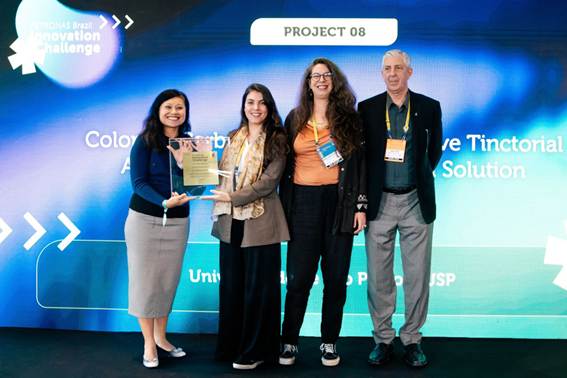
From left to right: Suhana Sidik, Country Chair of PETRONAS in Brazil; Thaís Silvestre Sanches Antichera, associate researcher at CCARBON/USP and Project Manager of Color for Carbon (C4C); Gabriela Brottos, from Agrofloresta Brottos; and Jonas Castro, Head of R&D at PETRONAS Brazil, during the award ceremony for Color for Carbon, a project selected in the PETRONAS Brazil Innovation Challenge, held at ROG.e 2026.
The pilot area will be established at Agrofloresta Brottos, in Itatiba, São Paulo, which will serve as an experimental platform for monitoring the transformation of areas originally dominated by pasture into a diversified agroforestry system.
The project is organized into four complementary workstreams: Agroforestry; Carbon & MRV; Natural Dyes; and Impact & Scale.
From an environmental perspective, changes in biomass and soil carbon stocks, soil quality and functioning, and biodiversity will be assessed as part of an integrated MRV system. In parallel, the project will follow the entire value chain from plant to pigment, including the extraction and characterization of natural dyes and evaluation of their application potential.
The proposal also investigates the economic and social viability of the model, seeking to understand how an agroforestry system focused on pigment production can generate new value chains and income opportunities while restoring the ecological functions of the landscape.
In this way, Color for Carbon aims to develop not only an experimental area, but also a replicable Nature-Based Solution model capable of connecting productive restoration, carbon, biodiversity, innovation, and socioeconomic inclusion.
CCARBON/USP at ROG.e 2026
The announcement of the winning projects took place during ROG.e 2026, one of the leading events in the energy sector, held at Riocentro in Rio de Janeiro.
CCARBON/USP was represented at the event by Tiago Osório Ferreira, the Center’s Dissemination Director and BlueRoots Coordinator; Rodolfo Fagundes Costa, Dissemination Manager at CCARBON/USP and Project Manager; and Thaís Silvestre Sanches Antichera, Color for Carbon Project Manager and Principal Investigator.
The participation also marked the beginning of a new stage in the collaboration between the Center and PETRONAS. Researchers associated with the Center are already conducting research in partnership with the company in the blue carbon field, and the new projects expand this cooperation to include new mangrove restoration strategies and regenerative agroforestry systems.
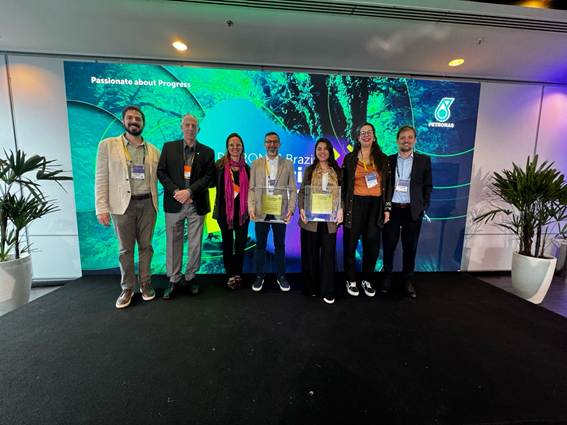
From left to right: Rodolfo Fagundes Costa, Dissemination Manager at CCARBON/USP and Project Manager; Jonas Castro, Head of R&D at PETRONAS Brazil; Flavia Freire, from the PETRONAS Brazil R&D team; Prof. Tiago Osório Ferreira, BlueRoots Coordinator and Dissemination Director at CCARBON/USP; Thaís Silvestre Sanches Antichera, associate researcher at CCARBON/USP, Principal Investigator and Project Manager of Color for Carbon (C4C); Gabriela Brottos, from Agrofloresta Brottos; and Murilo Medeiros, from the PETRONAS Brazil R&D team, during the celebration of the awards received by BlueRoots and Color for Carbon, selected in the PETRONAS Brazil Innovation Challenge during ROG.e 2026.
Different ecosystems, one common goal
Although BlueRoots and Color for Carbon work with very different ecosystems and productive systems, the two projects share a common CCARBON mission: to use science to better understand carbon capture and stabilization processes and, based on this knowledge, develop applicable solutions capable of generating benefits that go beyond carbon.
In mangroves, this means improving the way degraded ecosystems are restored and understanding how much additional carbon can be gained through new practices. In agroforestry systems, it means demonstrating that landscape recovery can go hand in hand with biodiversity, the production of renewable raw materials, and new economic opportunities.
With these two projects, CCARBON/USP expands its work in the development of Nature-Based Solutions supported by scientific evidence, connecting research, innovation, conservation, and social impact.
